Memory outside the context window.
An agent's window is a lens, not the store. Neomonic is the store: typed memos under topics under contexts, recalled by the keyphrases the agent already holds.
recall via keys mv-denver · sister Priya · PERSON
Three verbs, and the window stays small.
Every memo is one typed fact with a key. The agent keeps the keys hot in its window and pulls the payload only when a question needs it. That is the whole discipline, and it is what keeps a long-running agent from forgetting.
Add
One fact per memo, typed by what it is: a person, a place, a time, an action, a thing. Payloads go to the store, not the prompt.
memory.add caroline, moving, mv-denver, moved to Denver in MarchHold the keys
Loading a context loads its keyphrase cache: a few hundred bytes the agent carries between turns instead of the memos themselves.
memory.cachekeys carolineRecall
A question is matched against the keys first, the full-text index second. The hit comes back as the memo, with its type and its time.
memory.modelkeywords caroline, who helped with the moveWhat a store holds.
Built as the memory module of the 0verload tool federation: one C++ binary, no runtime, no cloud, the on-disk store yours to copy, version and inspect.
Contexts, topics, memos
A context is one person, project or agent. Topics are its chapters. Memos are the facts, each with a key, a type and a timestamp.
The temporal web
Every memo anchors to the most specific date it carries, so "last spring" and "before the promotion" are questions the store can answer.
Load-bearing words
A trained word net reads each memo and keeps the words that carry it: names, places, times, actions, things. Those words, paired, are the keys the index runs on.
Trains where the hardware is
The word net trains on any OpenCL GPU, NVIDIA, AMD or Apple silicon, with nothing to install, and serves on a plain CPU anywhere. One model file either way.
Automatic version control
Every save of every enrolled file is a version. Memory that can be rolled back is memory you can let an agent write to.
Speaks MCP
Every verb is a tool over the Model Context Protocol, so Claude Code, Cursor or any MCP client gets persistent memory in one config line.
Measured, not promised.
Numbers from the benchmark lanes the product is developed against, on a desktop with a GTX 1660. Each is reproducible from the repository's own tools.
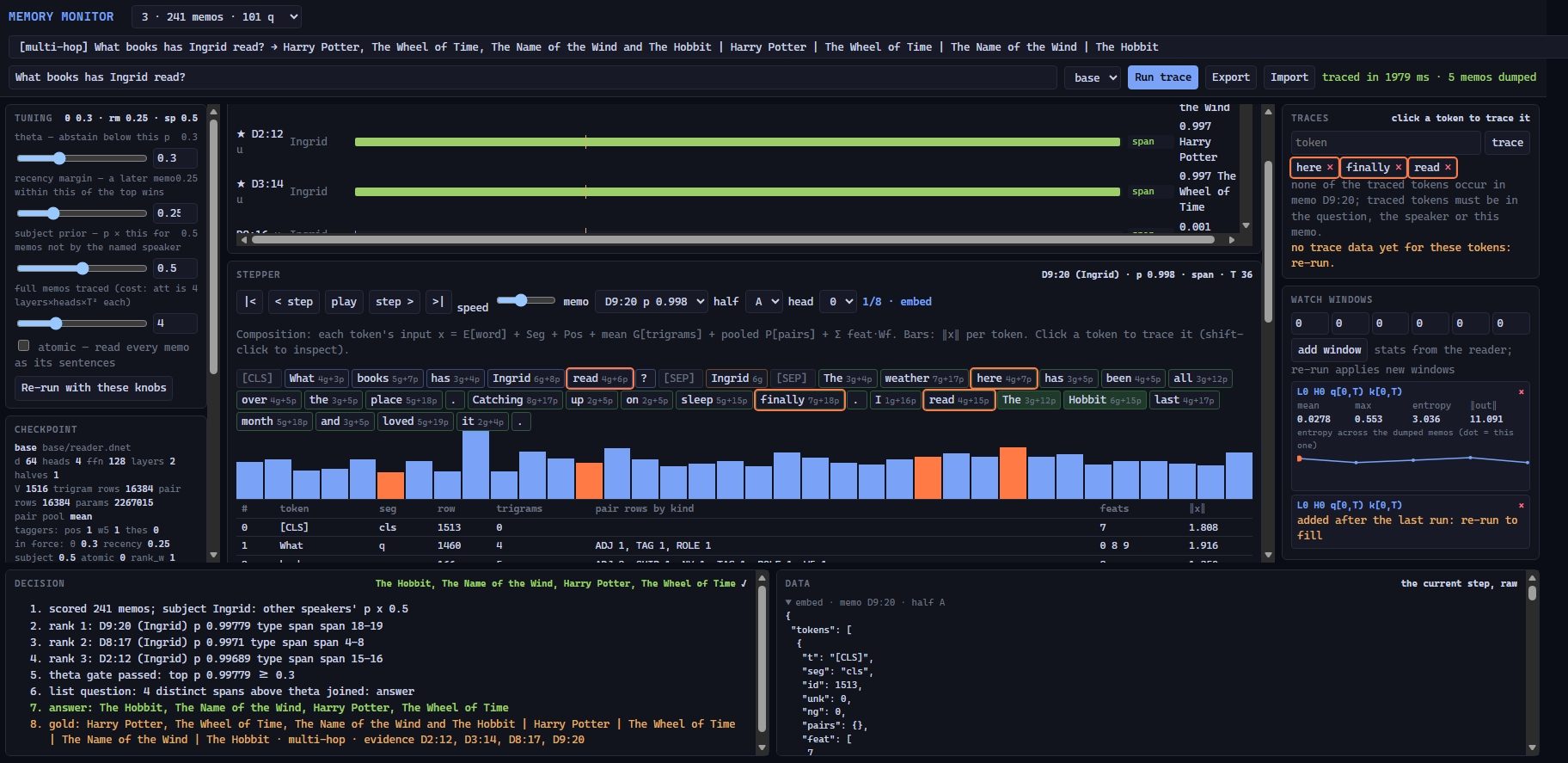
Watch it think.
The memory monitor traces one question through the store: every memo scored, the winners stepped token by token, and the decision written out line by line. Nothing in the answer is hidden behind a model call.
For agents, from the first turn.
Register the server once. The agent then recalls before it assumes it is starting fresh, and saves durable facts as it works, so they outlive the window.
- memory_addremember one typed fact under a context and topic
- memory_cachekeysload a context's keyphrase cache into the window
- memory_keywordsrecall by keyword when the keys do not hit
- memory_temporalask by time: before, after, around a date
- memory_w5who, what, where, when, why over a context
- memory_recentresume where the last session stopped
// claude_desktop_config.json / .mcp.json
{
  "mcpServers": {
    "neomonic": {
      "command": "0neo",
      "args": ["mcp"]
    }
  }
}

// or over HTTP, served by the resident
"url": "http://127.0.0.1:9966/mcp"